Saturday, April 4, 2009

Meta Ad

While this was the lead story in April 3rds AAF SmartBrief, I want to weigh in with my thoughts all the same - and who knows, maybe you missed it. An article on NYT.com (quoted below) discussed the unique meta ad approach of a new advertising campaign by Health Choice. I really like the idea they went with for the campaign; a behind the scenes look at the conversation between the spokesperso, Ms. Louis-Dreyfus, and her agent as they discuss the potential ad deal. It's not that new of an idea, and it feels a lot like The Office, but it's something that people really like right now.

Further, I think the whole meta ad idea ties into the conversation about problems in the industry concerning how people relate to and trust the messages they see in ads. As Luke Sullivan points out in the intro of "Hey Whipple, Squeeze This," people used to trust advertising, but it's no secrete that they don't anymore, in fact lots of people claim to despise it. And, these days Gallup polls regularly show advertising practitioners on par with car salesmen and members of Congress when it comes to least-trusted professions.

The point here is that any agency and client wants people to watch and believe their ads. But how can that be effectivly accomplished when, for some or many people, the credibility of message is already significantly hurt by the medium before we even see the first second of the ad? That's a pretty tough handycap to start with.

I suppose the truth of the matter is that it's not all that bad, not everyone thinks ads are lying and those that do still take in the message, even if with a grain of salt. But still credibility is an important issue all the same. We want ads to be trustworthy. It's something that most ads struggle with, and while I'm not sure if this Health Choice campaign will overcome it, I think it's a pretty good way to try.

'The premise of the commercials, which are directed by Christopher Guest (director of Spinal tap), is that Ms. Louis-Dreyfus is not really sure whether she wants to endorse Healthy Choice.

“It’s a ‘meta’ thing,” said Kathy Delaney, president and chief creative officer at Nitro, “advertising imitating life imitating advertising.”

The device enables the spots to convey information about Healthy Choice in a way that “never feel forced,” Ms. Delaney said, as Ms. Louis-Dreyfus and other characters discuss the reinvention,' (NYT.com via AAF SmartBrief).

Wednesday, April 1, 2009

April Fools Jokes by Brands

The Taco Liberty Bell 1996: The Taco Bell Corporation announced it had bought the Liberty Bell and was renaming it the Taco Liberty Bell. Hundreds of outraged citizens called the National Historic Park in Philadelphia where the bell was housed to express their anger. Their nerves were only calmed when Taco Bell revealed, a few hours later, that it was all a practical joke. The best line of the day came when White House press secretary Mike McCurry was asked about the sale. Thinking on his feet, he responded that the Lincoln Memorial had also been sold. It would now be known, he said, as the Ford Lincoln Mercury Memorial.

Virgin Cola’s Blue Cans 1996:
In 1996 Virgin Cola announced that in the interest of consumer safety it had integrated a new technology into its cans. When the cola passed its sell-by date, the liquid would react with the metal in the can, turning the can itself bright blue. Virgin warned that consumers should therefore avoid purchasing all blue cans. The joke was that Pepsi had recently unveiled its newly designed cans. They were bright blue.

The Left-Handed Whopper
1998:
Burger King published a full page advertisement in USA Today announcing the introduction of a new item to their menu: a "Left-Handed Whopper" specially designed for the 32 million left-handed Americans. According to the advertisement, the new whopper included the same ingredients as the original Whopper (lettuce, tomato, hamburger patty, etc.), but all the condiments were rotated 180 degrees for the benefit of their left-handed customers. The following day Burger King issued a follow-up release revealing that although the Left-Handed Whopper was a hoax, thousands of customers had gone into restaurants to request the new sandwich. Simultaneously, according to the press release, "many others requested their own 'right handed' version."

Soy Bomb Lands Record Contrac1 1998:
Viewers of the February 1998 broadcast of the Grammys were surprised when a semi-naked man with the word 'Soy Bomb' scrawled on his chest danced out onto the stage during Bob Dylan's solo performance. The man (who was definitely not supposed to be there) was quickly escorted away by security guards. But a few months later, on April 1, Rhino Records proudly announced that it had signed Soy Bomb (as he was now known) to a two-year, six-album recording contract. Soy Bomb's first album would include covers of popular classics such as 'Dancing Machine' and 'You Dropped a Bomb on Me.' A spokesman for Rhino Records commented that they had been moved to offer Soy Bomb a contract because the experience of watching him dance had been for them "kind of like
when you eat too many Whoppers and you feel a little nauseous,
but you're so happy you ate them."

Bank Teller Fees 1999:
In 1999 the Savings Bank of Rockville placed an ad in the Connecticut Journal-Inquirer announcing that it would soon begin charging a $5 fee to customers who visited a live teller. The ad, which appeared on March 31, claimed that the fee was necessary in order to provide, "professional, caring and superior customer service." Although the ad was a joke, many customers failed to recognize it as such. One woman reportedly closed her account because of it. The bank then ran a second ad revealing that the initial ad was a joke. The bank manager commented that the first ad ironically "commits us to not charging such fees."

Miller Lite 2000:
In 2000 Miller Beer announced that it had struck an agreement with the town of Marfa, Texas to become the exclusive sponsor of the phenomenon known as the Marfa Mystery Lights. These are spherical lights which appear south of the town each evening, seeming to bounce around in the sky. They're variously rumored to be caused by ghosts, swamp gas, or uranium (though they're probably caused by the headlights from the nearby highway). Miller announced that under the terms of the agreement the Marfa Lights would be renamed the Miller Lites. The local paper, which was in on the joke, printed the news on its front page.

These were taken from http://www.museumofhoaxes.com/hoax/aprilfool/P90/

Friday, March 27, 2009

Survey Time

To whom it may concern,

Myself and several other Suffolk University students are conducting a survey about how people get their mail. As part of a semester long project for a class on Advertising Campaigns we are looking to gather information primarily from homeowners. The survey is 5 pages long, about 50 questions, and should take between 10 and 15 minutes to complete. Further, if you wouldn't mind passing it onto other homeowners you know we would greatly appreciate it.

Click Here to take survey

Thank you,

Suffolk Ad Students

Friday, March 20, 2009

Obama ≠ Brand

Obama a President not a brand I say?

The notion of Obama as a brand is sexy. Articles in Time, Newsweek, Fast Company, The Herald Tribune, AdAge and countless blogs including HarvardBusiness.org and Politico.com have all found great stories in the similarities between Obama’s presidential campaign and the marketing world. Further, they offer insights into how his campaign may have valuable lessons for marketers!

The idea that political campaigns can be conceived of as brands is nothing new. Today, however, we seem to be more enchanted with this idea than ever. Probably because it feels clever, and arguably it is - Obama is after all the first presidential candidate we’ve had that had with his own logo (I don’t count Bush’s W for several reasons). Further, in a consumer oriented economy this logic is the zeitgeist of our era - during the industrial revolution everything was described in terms of how they were like machines - and it makes sense to frame things in this way.

But, campaigns are not quite marketing campaigns, and Obama is not exactly a brand himself either, and in the excitement I think that we tend to ignore where corporate brands and political campaigns do not line up. In my ongoing studies of the Obama campaign I’ve made some observations about the differences. Here are just a few.

First, what is being sold? Voting for president is a high involvement decision with a high, and unique cost. People have strong emotions about politics and a lot invested in the outcome of an election – we’re being sold the future not a jacket. Some people were looking to “buy” hope and change, but as much as Coke and Pepsi try they cannot promise the same national and even global return on these commodities that Obama could. Therefore soda has much more trouble getting people to invest strongly and deeply emotionally in their brands. Families don’t split on soda the same way they do about politics. Further, the cost of a vote is more intangible than money. We all have one, but only one. A coupon for Obama wouldn’t get a McCain supporter to “try it out.” Presidential candidates are a product category so removed from anything else that I’m not sure it’s a category at all.

Nike and Apple do not exist in a state of constant crisis communication. Campaigns fire back and forth every day over every medium. Moreover, the media discussed the events 24/7, bringing in surrogates and pundits to discuss image and policy issues for every news cycle. Corporate brands simply do not exist in the same information environment as politics, and therefore their communication strategies will no doubt need to be significantly different.

Finally, campaigns are made of multiple, interlocking, overlapping identities. First Obama’s identity was defined both by the combination of his campaign’s message and his party affiliation. After winning the nomination his identity changed once again as his context changed, he was the same product sure, but in the entirely new market of the general election – and was thus perceived differently. Then his choice of Joe Biden as the vice presidential nominee had a significant impact on his image (as Did Sarah Palin for John McCain). Further, endorsement of unions, fellow politicians and celebrities all added up to much more than 4 out of 5 doctors prefer Crest or Tiger Woods on a Wheaties box.

These ideas are still quite fluid for me and I’d welcome some outside perspectives on this (especially if they disagree). There are certainly many parallels between political campaigns and marketing, and they are quite valuable. Moreover, I believe there is a lot that the Obama “ahem” brand can offer to marketers in terms of insight. But, I think we need to be clear about the differences if we are to really learn from the comparison.

Wednesday, March 18, 2009

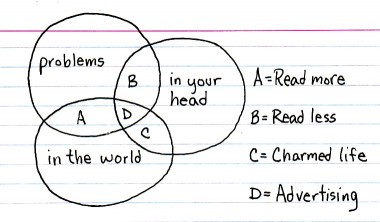
Problems you didn’t even know you had.

Things like this (see below and corresponding comments on website) always make me wish advertising had a better track record. Or at least wasn't perceived so negatively. As if it's the ultimate enemy of real culture. Don't ads make some aspects of culture possible in the first place? Or if the Met advertises would these same critics still take issue? I don't mean to be flip, I just wish there were more dialogue.

Maybe we need to start advertising advertising...? It's dripping with irony. It's rebellious. It's antidisestablishmentarianism. The kids will learn to spell that and put it on their skate boards!

Probably a bad idea...

via Indexed

PS I love Indexed. I hope I did not unintentionally insinuate otherwise above.

Shout Out Returned


A friend of mine graciously cited me in a post of his, and I thought I would return the favor by passing it around. It's a great piece that I really had nothing to do with, but he gave me a shout out. So here's to you Derek Gildea! and your fabulous post.

Keeping up with the Technology Curve

<-- The man himself.

Monday, March 16, 2009

A Dear Jon to the Media

Dear TV News Media,

Hi, this is the millennial generation and I think we should talk. I know that we’ve been growing more distant over the years. And well, try as you might, you have no idea how to give us what we want – though we tell you that it’s just for you to do your job – so we (the largest generation in American history) are leaving you. Also, we’d like to say that it’s not us, it’s you. In fact, it’s pretty much all your fault.

FOX, we never really liked you anyways; even young conservatives change the channel. MSNBC, Brokaw was great, but when was the last time Chris Matthews didn’t talk? CNBC, you’re so done, sorry. CNN, nobody likes Lou Dobbs; seriously who watches that? And the “No Bias, No Bull” with Campbell Brown... please just call it the News with Campbell Brown. Finally, C-Span and BBC, any chance we can find you in the HD channels? I’m kidding... not really though.

You tried to win us back CNN, when you tried “D. L. Hughley Breaks the News,” but what we love about guys like Jon Stewart is not just the funny, but also the actual news. Why, we ask again and again and again: why do we hear about the most important news items to us from JON and not YOU? Why do we get insightful opinion from JON and not YOU? We know the Daily Show is not news, and we don’t really want it to be either (and neither does Jon for that matter). But YOU drop the ball seemingly every time! So what choice do we have?

Stewart’s most recent interview with Jim Cramer is a great example of our problem here, but for a reason you might not expect. You didn’t get what we loved about it. Cramer thought Jon was attacking him, but he was attacking the whole industry, YOU. All your commentary afterwards was about who “won” the interview, and you missed that Stewart and all of us were laughing (and disappointed) with YOU. The clips from CNBC that Stewart played showed tacky graphics and overproduced promos for alleged news shows that amounted to nothing more than reading press releases from these big companies they are supposed to be reporting on. Afterwards you should have gone and looked in the mirror.

Most nights Stewart doesn’t have to try to make jokes, he simply plays clips from your 24 hour news casts and we laugh, because unedited they are hilarious and absurd. In fact, we’ve noticed that these days he focuses on criticizing the media rather than politics and the news, and we laugh and laugh. But then we get a little sad, because it’s not satire, it’s real and you really have no idea. You are awful at your job and we all hurt because of it.

I guess what I’m saying is that until you get yourself together, we’re leaving. Not for Jon in particular, but for news like his. I’m sorry it had to happen like this, But, it was just a matter of time.

Best,

Most everyone born between 1976 – 1996.